Artificial Intelligence (AI) is making waves across medicine — and DentoMaxilloFacial Radiology (DMFR) is no exception. From automated image analysis to predictive diagnostics, AI promises to enhance accuracy, efficiency, and clinical outcomes. But how much of this is grounded in reality, and how much is just hype?
Let’s take a closer look at how AI is being used in DMFR today — and what the future might hold.
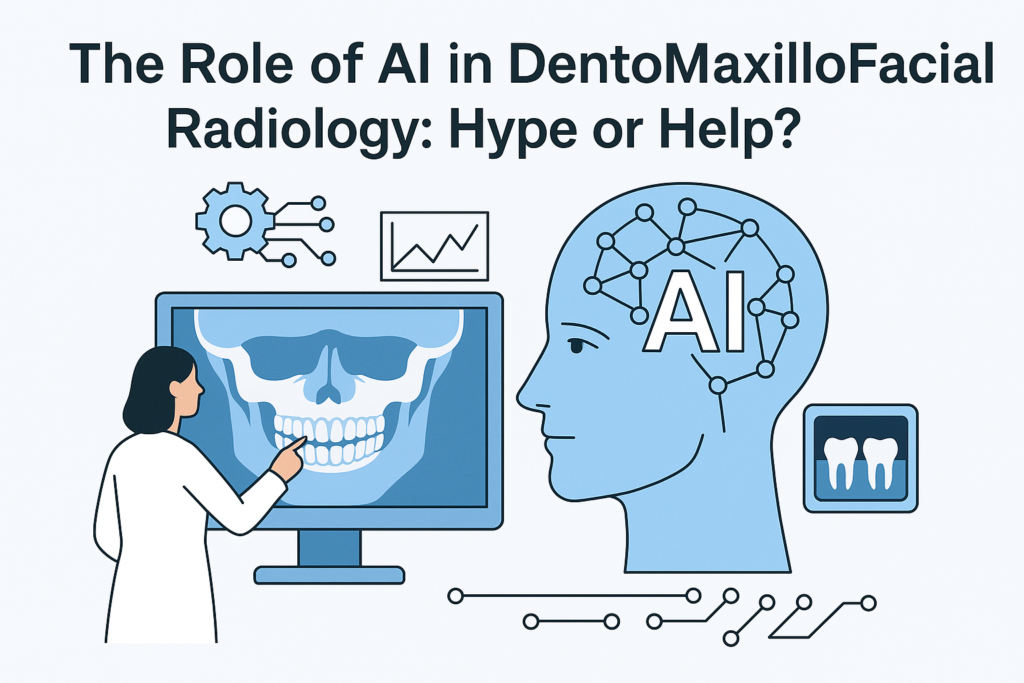
A New Era of Diagnostic Support
Radiographic interpretation lies at the heart of DMFR. Traditionally, this has relied heavily on the expertise of trained radiologists. But AI-powered tools are now being developed to support — not replace — that expertise.
Several systems are capable of:
- Detecting lesions or abnormalities on panoramic and CBCT images
- Highlighting anatomical landmarks for treatment planning
- Flagging potentially missed findings in complex scans
These systems are often trained using thousands of annotated images and continue to “learn” as more data becomes available.
Efficiency Without Compromise?
AI tools can significantly reduce the time spent on image review and reporting, particularly in high-volume clinics. By automating parts of the workflow (e.g., pre-screening, annotation, report drafting), clinicians can focus more on decision-making and patient communication.
However, concerns remain around:
- Accuracy across diverse populations
- Data privacy and ethical use
- The potential for over-reliance on algorithms
As with any new technology, proper validation and clinical oversight are essential.
Current Use Cases in DMFR
AI is already being integrated in several areas of dental radiology:
- Caries and bone loss detection in bitewings and panoramic radiographs
- CBCT analysis for airway evaluation or implant planning
- Orthodontic cephalometric tracing
- Risk stratification in pathology (e.g., cystic lesions or TMJ disorders)
While results are promising, most AI tools are still seen as adjuncts to — rather than replacements for — human expertise.
Training the Next Generation
As AI becomes more embedded in DMFR, radiologists will need to understand how these tools work, where they add value, and where they may fall short.
EADMFR is committed to supporting this evolution through:
- Workshops and webinars on AI in imaging
- Collaborative research into algorithm validation
- Discussions on the ethical integration of AI into clinical workflows
The Verdict: Hype or Help?
While there is no doubt that AI is still maturing in dental and maxillofacial imaging, it already offers real, tangible benefits — especially when used responsibly alongside clinical expertise.
It’s not about replacing radiologists. It’s about amplifying their capabilities, reducing cognitive load, and ensuring better patient outcomes.
In other words: AI is help — not hype.
Interested in the latest research or tools related to AI in DMFR? Subscribe to our newsletter or check out upcoming sessions at the next EADMFR Congress.